Robot Control Platform

Product Highlights

Cedar Spark Robot Control Platform

Control Systems

Product Overview

The Cedar Spark Robot Control Platform is built on the CODESYS programming environment and aligned with the IEC 61131-3 standard. It is designed for robot and automation control applications, with support for multiple robot structures, customized applications, multi-machine control, and open interface integration.

Cedar Spark positions this platform as a full robot control system rather than a simple control accessory. It combines an open architecture, strong integration capability, and direct accessibility to both the PLC and robot control sections.

Result Highlights
•
Supports multiple robot structures and fast deployment
•
Supports multi-machine control and open interface integration
•
Supports custom PLC programming and direct access to the control layer
Key Benefits
▸ Open Interface Architecture Built for integration across different automation structures and system requirements.
• More than 95% of interfaces are open
• The state machine code is fully open
• PLC programming can be customized
• The PLC layer and robot control layer can be accessed directly
▸ Multi-Structure Support Designed for different robot structures and customized control applications.
• Supports different robot configurations
• Supports customized applications
• Supports a wide range of robot configurations
• Enables rapid deployment across different robot structures
▸ Multi-Machine Control A stronger fit for coordinated automation and more complex control logic.
• Supports multi-machine control
• Supports optimal speed-planning algorithms
• Supports advanced speed look-ahead
• Better suited to coordinated control across multiple units
▸ Flexible Development and Integration Highly configurable at both the software and PLC levels.
• Built on CodeSys (IEC 61131-3)
• Supports ST
• Supports Ladder Diagram
• Supports Sequential Function Chart and other PLC languages
System Configuration
How It Works

The platform is built on the CodeSys environment and serves as the core control system for robots and automation equipment. It can be configured for different robot structures and customized applications, using motion control, speed planning, and multi-machine logic to execute control tasks.

In operation, the controller handles the main control and real-time computation, while the teach pendant provides user interaction and operating input. The PLC layer can be programmed to match on-site requirements, and direct access is available between the PLC layer and the control layer.

For more complex automation scenarios, The platform also supports multi-machine control, open interface integration, and multiple communication protocols. This gives the system stronger structural flexibility and better integration potential.
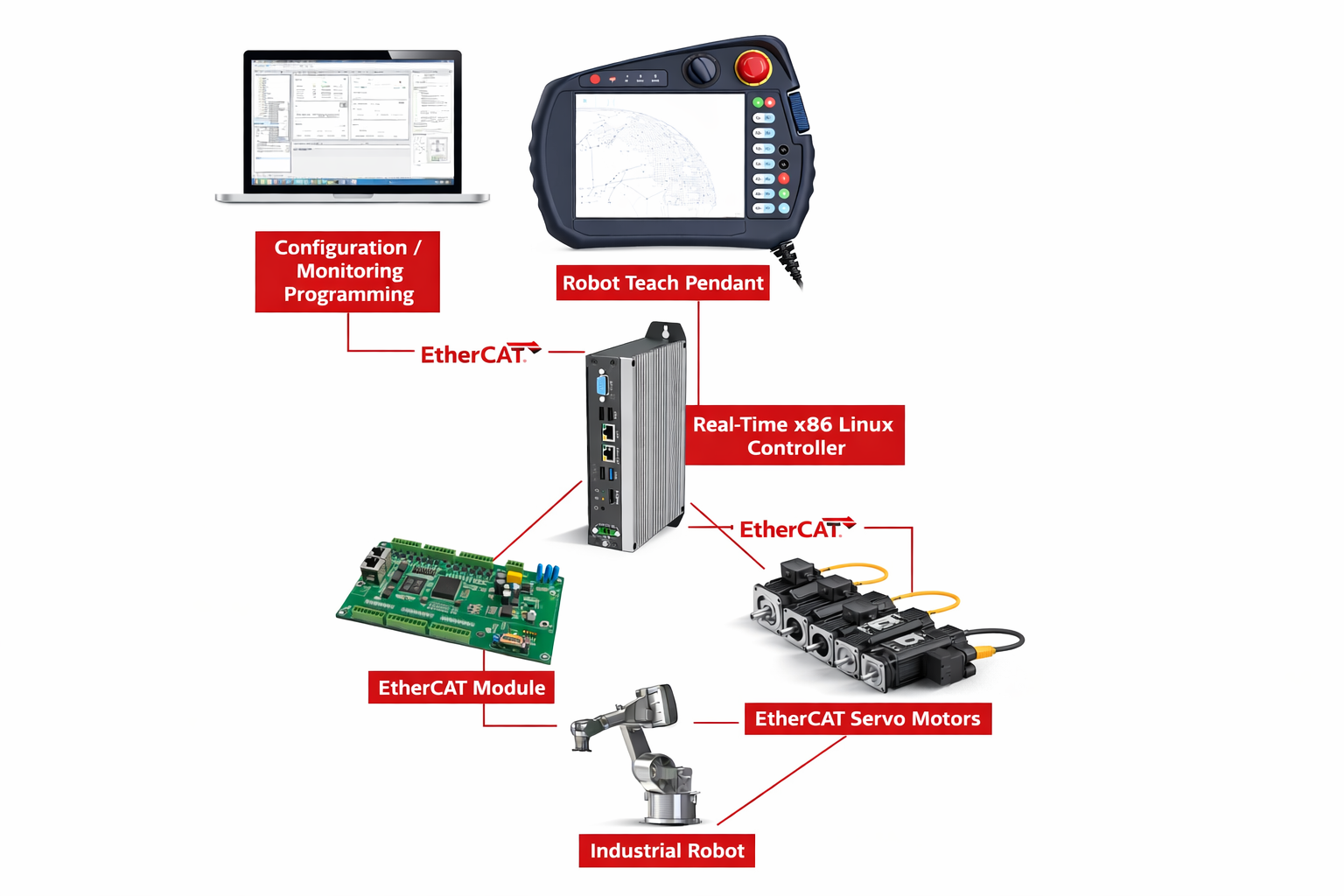
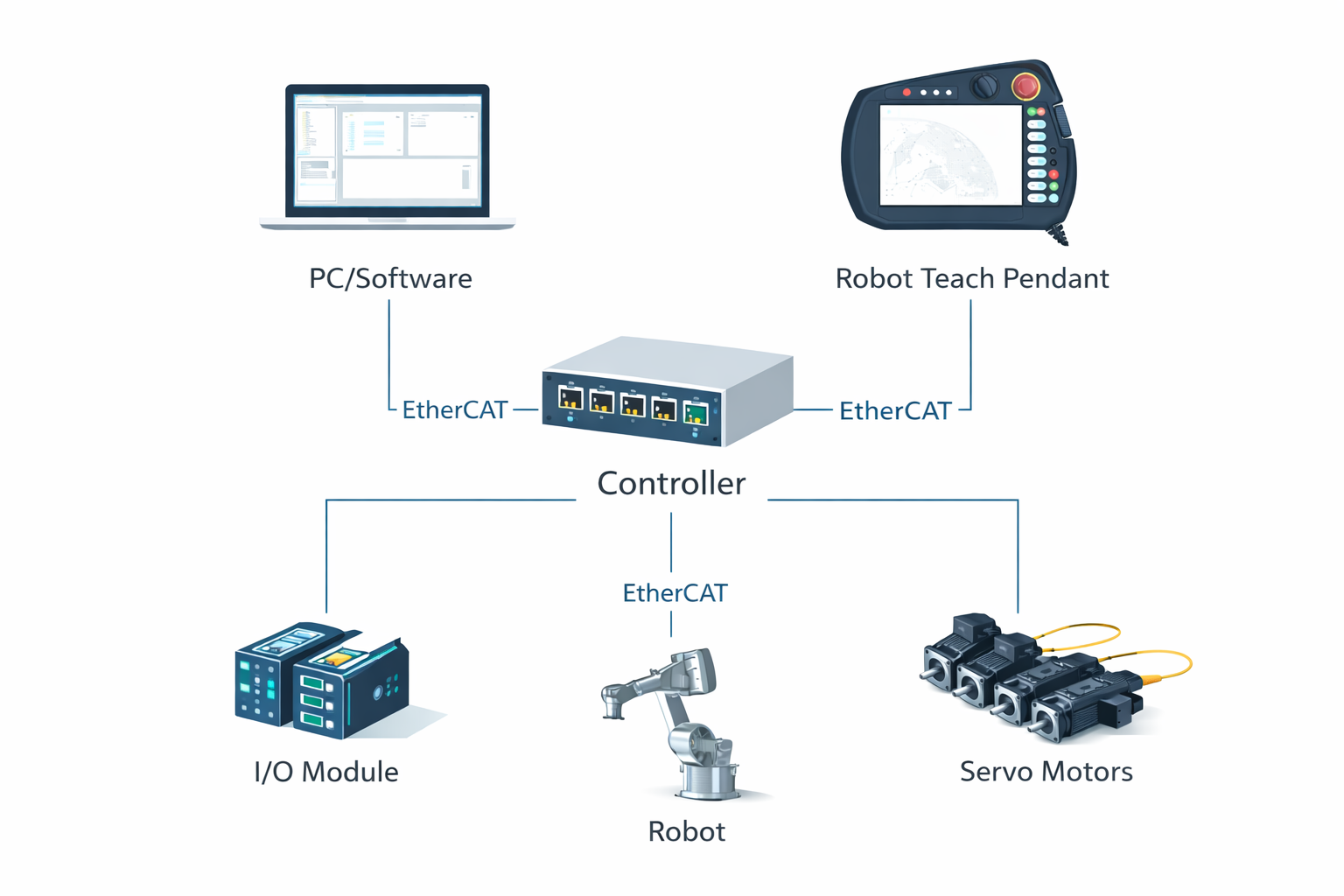
Robot control platform configuration visual
Key Technical Data
Teach Pendant Processor
ARM Cortex-A8 800MHz
Teach Pendant Memory / Storage
256MB, eMMC 4GB
Teach Pendant Display
TFT 8 inch, 800 × 600; rugged 4-wire resistive touch screen
Controller CPU
Celeron J1900, 4 cores, 2.0GHz
Controller Memory / Storage
DDR3 4G, 32G
I/O and Analog Output
16 DI / 16 DO (PNP), two 0–10V analog outputs
Additional Notes
• Ethernet ports: 2 × I210
• Teach pendant weight: 1.2kg
• Encoder support: Yes
• Pendant-free operation: Supported
• STO control: Supported
• External mode selection signal: Supported
• External power-on: Supported
• High-voltage control: Supported
Core Components
Pendant

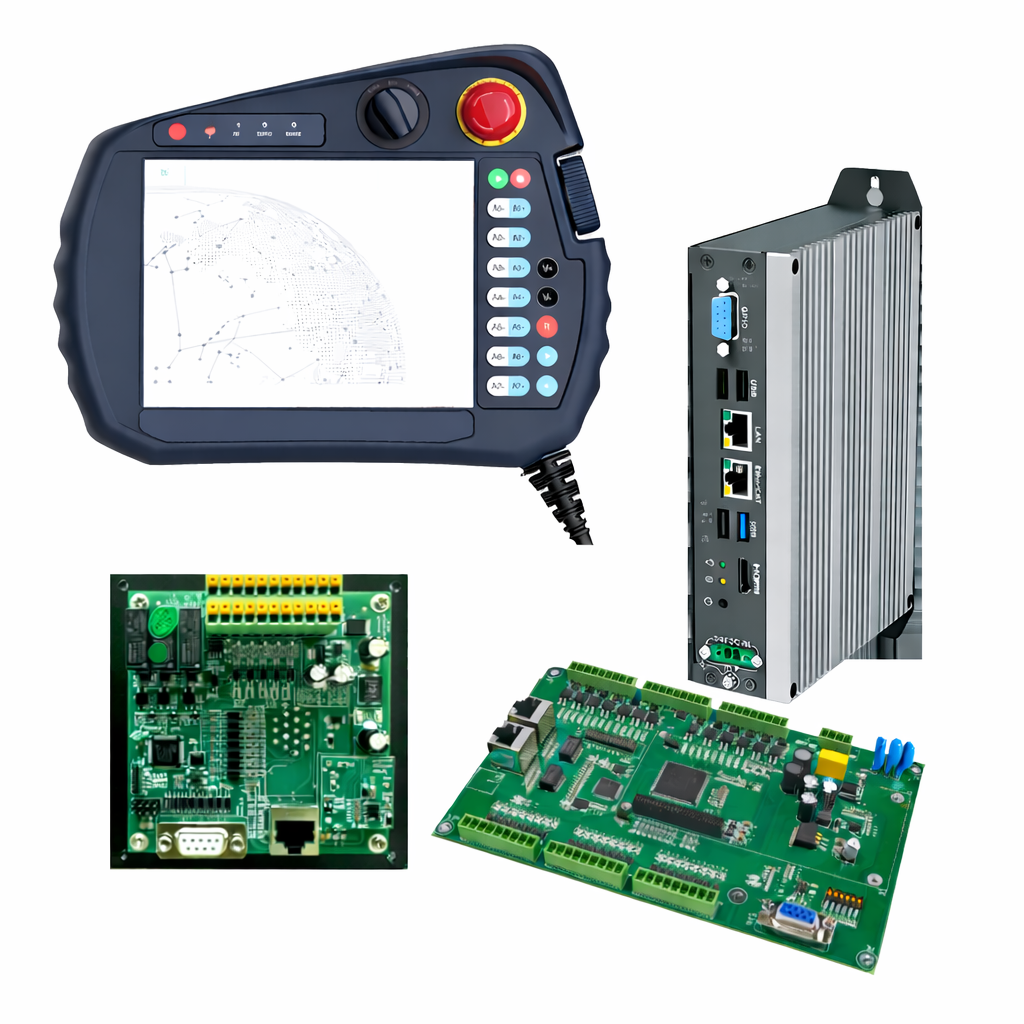
The teach pendant serves as the system’s human-machine interface and on-site operating input device. It uses an ARM Cortex-A8 800MHz processor, with 256MB memory and eMMC 4GB storage. The display is an 8-inch TFT screen with 800×600 resolution and a reinforced 4-wire resistive touchscreen.

It runs Linux 4.9.65 and supports the QT 4.9.65 development environment. Functional components include an emergency stop, mode selector, electronic handwheel, stylus, and a three-position enabling switch. At 1.2kg, it combines operating input with the safety and interaction requirements of industrial control.

• ARM Cortex-A8 800MHz
• TFT 8 inch, 800×600
• Linux 4.9.65 / QT 4.9.65
• Emergency stop, electronic handwheel, three-position enabling switch
• Weight: 1.2kg
Controller

The controller is the core computing and execution unit of the platform. It uses a Celeron J1900 CPU with 4 cores at 2.0GHz, supported by DDR3 4G memory and 32G storage, and provides 2 × I210 Ethernet ports.

In safety and I/O terms, the system supports high-voltage control, STO control, external gear-position signals, external power-on, pendant-free operation, encoder functionality, 16 DI / 16 DO (PNP), and two 0–10V analog outputs. This makes it suitable not only for standard control tasks, but also for industrial integration and future expansion.

• Celeron J1900, 4 cores, 2.0GHz
• DDR3 4G, 32G
• 2 × I210 Ethernet ports
• 16 DI / 16 DO (PNP)
• Two 0–10V analog outputs
• Multiple safety and external control functions supported
Software & Communication

Software and communication are among the platform’s strongest capabilities. The display side runs on an ARM-based Linux system, while the controller uses an x86-based 64-bit real-time Linux operating system. The PLC layer is built on CodeSys and supports ST, Ladder Diagram, Sequential Function Chart, and other PLC languages.

In communication, the system supports EtherCAT, Modbus RTU master/slave, Modbus TCP master/slave, EtherNet/IP, and CAN. This makes it suitable not only for standalone control, but also for system networking, protocol integration, and expansion into more complex automation environments.

• ARM-based Linux system
• x86-based 64-bit real-time Linux operating system
• PLC built on CodeSys
• Supports ST / Ladder Diagram / Sequential Function Chart
• Supports EtherCAT / Modbus RTU / Modbus TCP / EtherNet/IP / CAN
Integration Capability
The value of the platform goes beyond control execution. It is built for integration, expansion, and customization. With CodeSys (IEC 61131-3), multi-structure support, multi-machine control, open interfaces, and customizable PLC capability, The platform is better understood as an open robot control system rather than a closed black-box module.
Integration & Communication
Core Support
• Supports EtherCAT
• Supports Modbus RTU master/slave
• Supports Modbus TCP master/slave
• Supports EtherNet/IP
• Supports CAN
Additional Note
The platform is designed for robot and automation control applications. Its value lies in system integration, protocol access, and control expansion. With open interfaces, high accessibility, and customizable PLC capability, it is well suited to applications that require multi-device coordination, on-site customization, and future functional expansion.
Robot control platform integration and communication